
MARKETING · DIGITAL STRATEGY
A natural, readable look at why digital personalities are becoming useful far beyond social media, and how they can make a website feel more alive, more consistent, and more effective at turning attention into action.
Most websites do not have a traffic problem. They have a presence problem.
You can spend money on design, polish the copy, run ads, improve the logo, and still end up with a site that feels strangely lifeless. Everything looks correct, but nothing really pulls people in. The page sits there like a brochure. It waits for the visitor to do all the work.
And that is usually where things start to fall apart.
People do not arrive on a website in a patient, thoughtful mood. They arrive distracted. They arrive skeptical. They arrive with a few seconds of attention and a quiet question in the back of their head: “Am I in the right place?”
If the site cannot answer that fast, most of them are gone.
The shift from novelty to usefulness
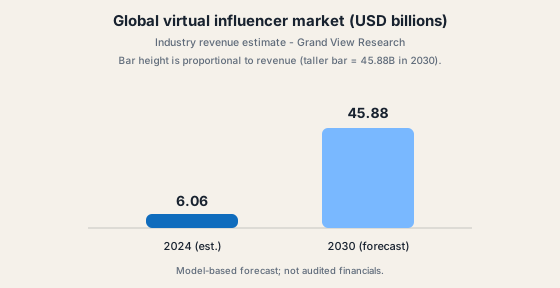
That is exactly why AI influencers are becoming more interesting than they first sound. At first glance, the phrase makes people think of virtual models, fake Instagram accounts, or some trendy digital character trying to act human online. That version exists, sure, but it is also the least interesting version of the whole idea.
The more useful version is this: an AI influencer can be the face, voice, and personality that helps your brand communicate better.
Not louder. Better.
It can explain what you do. It can make content feel connected across platforms. It can guide visitors through your site. It can keep your marketing active without forcing your team to build every single asset from scratch. And when it is done well, it can make a business feel more alive in a way that static content usually cannot.
That is why this is bigger than a social media trend. It is really about presence.
Speed changes the equation
Speed is the first obvious advantage, and maybe still the most important one.
Marketing today is hungry all the time. It wants new ad creatives, new hooks, new short videos, new landing page content, new social posts, new email angles, new tests, new versions, new updates. Even when a brand has good ideas, turning those ideas into enough usable content is a constant struggle.
That is where an AI influencer can quietly change the math.
Instead of starting from zero every time, a business can build around a recognizable digital identity. The face is familiar. The tone is familiar. The style feels connected. That makes it much easier to create more content without making the brand feel inconsistent or chaotic.
And that matters because great marketing rarely comes from one perfect idea. It usually comes from repeated testing, repeated improvements, and the ability to keep showing up without running the team into the ground.
That alone makes AI useful.
Consistency becomes a real advantage
But speed is only half the story. The other half is consistency, and honestly, that may be even more valuable over time.
A lot of brands do not really look weak because they lack content. They look weak because their content feels disconnected. The website sounds corporate. The short videos sound casual. The ads sound aggressive. The product pages sound like they were written by a completely different person.
Even if each piece is decent on its own, the overall impression feels messy.
A well-built AI influencer can fix that because it gives the brand a recurring identity. Over time, that identity becomes a thread running through everything: the homepage, the videos, the campaigns, the explainer content, the social posts, even the support experience. Suddenly the whole business feels like it is speaking with one voice.
That kind of coherence is powerful. People may not remember every line of copy they read, but they absolutely remember whether a brand felt clear and recognizable.
Why this works especially well on websites
Nowhere is this more useful than on the website itself.
Most sites still behave like static displays. They hand visitors a pile of information and hope people sort it out on their own. But that is not how real users behave. Real users hesitate. They skim. They get confused. They wonder which product fits them. They compare options. They look for one small sign that says, “Yes, this is for you.”
That is where an AI influencer starts doing real work.
It can show up as a short homepage explainer. It can act as an interactive guide on a product page. It can answer common pre-sale questions. It can help point different visitors toward different offers. It can even make the site feel more welcoming simply because there is now some kind of human-like presence helping people move forward.
That may sound small, but those small moments are often where conversions are won or lost.
Most people do not leave because they are completely uninterested. They leave because they are almost interested, but not enough. Almost convinced, but not quite. Almost ready to click, but still carrying one or two questions that the page never resolves.
A useful AI persona can close that gap.
And once you see it that way, the whole concept becomes much less about novelty and much more about conversion.
The best AI influencer is not the one that looks the most futuristic. It is the one that makes your marketing clearer and your website easier to act on.
Better ads, better testing, more mileage
The same thing applies to paid ads and content testing.
Every marketer knows the pain of creative fatigue. Something works for a while, then it flattens out. You need a new angle, a new opening, a new variation, a new message for a slightly different audience. Traditional production can handle that, but slowly. It takes more planning, more revisions, more filming, and more cost.
An AI influencer gives you more room to move.
You can keep the same recognizable brand face while changing the message around it. One version can speak to cold traffic. Another can be built for retargeting. One can lean emotional. Another can be straight to the point. You can create different versions for different countries, different customer types, or different stages of awareness without rebuilding the whole thing from scratch.
That flexibility is not just convenient. It creates leverage.
And leverage is exactly what smaller teams need.
Why smaller teams should care
This might be the strongest practical case for AI influencers: they help smaller businesses look bigger than they are. A lean company can show up with more consistency, more frequency, and more polish than it could a few years ago. It can test more ideas. Keep more campaigns fresh. Build a more active-looking brand. Expand into more formats and more markets without multiplying production costs at the same rate.
That does not mean AI replaces strategy. It does not fix a weak offer. It does not magically make boring marketing interesting. But it does give a solid business more ways to express itself, and that matters a lot when attention is scarce.
Ownership matters too
There is also a long-term branding benefit that should not be ignored: ownership.
When you work with traditional influencers, you are borrowing someone else’s voice and someone else’s audience. That can absolutely be useful, but it also comes with limits. Their schedule matters. Their style matters. Their public image matters. And in many cases, people remember the creator more than they remember the brand that paid them.
A brand-owned AI influencer works differently.
The persona belongs to the company. The tone belongs to the company. The look, the scripting, the appearances, the long-term evolution, all of it stays under the brand’s control. Over time, that can become a real asset. Not a rented moment of attention, but something that directly strengthens your own identity.
That is part of what makes this trend more than a gimmick. It is not just about generating content faster. It is about building brand presence in a way that can compound.
Where brands can still get it wrong
Of course, there is still one very obvious way to ruin it: make it feel fake in the worst possible way.
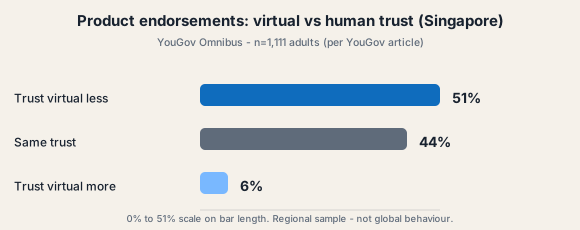
If an AI influencer exists only to show off the fact that it is AI, people will get tired of it fast. If it tries too hard to pass as human, trust drops even faster. If it adds noise without adding clarity, it becomes just another shiny object sitting on top of weak marketing.
That is the trap.
The best AI influencer is not the one that screams, “Look what technology can do.”
It is the one that makes the customer experience smoother.
It explains. It guides. It reassures. It saves time. It gives the brand a stronger presence.
That is why usefulness matters so much more than novelty here. People care far less about whether something is AI-assisted than marketers often assume. What they actually care about is whether it helped them understand something faster, feel more confident, or make a decision more easily.
If the answer is yes, the tool is doing its job.
How to start without overcomplicating it
And if you are wondering where to begin, the smartest answer is to start smaller than your ego wants to.
Do not try to build the next viral digital celebrity on day one. Do not start with ten channels, fifty content ideas, and a giant artificial personality strategy. That is how businesses end up chasing hype instead of results.
Start with one job.
Maybe your homepage needs a stronger introduction. Maybe your paid ads need more creative variation. Maybe your visitors keep asking the same pre-sale questions. Maybe your brand feels inconsistent from one platform to the next. Maybe you want to expand into more languages without tripling the amount of production work.
Pick one of those problems and solve that first.
Build one useful digital spokesperson. Or one on-site guide. Or one recurring AI-driven creative system.
Give it a real role. Measure what changes. Watch whether people engage longer, understand faster, click more, or convert more smoothly.
That is when the value becomes clear.
The real takeaway
Because the truth is, AI influencers are not really powerful because they are artificial. They are powerful when they help a brand feel more present, more responsive, and more coherent at scale.
That is a very different thing.
And it is also why this idea is not going away.
The businesses that win with it will not be the ones making the flashiest virtual personalities. They will be the ones using digital presence in a practical way, to make their site more helpful, their marketing more flexible, and their brand more memorable from one touchpoint to the next.
That is not hype. That is an actual advantage.
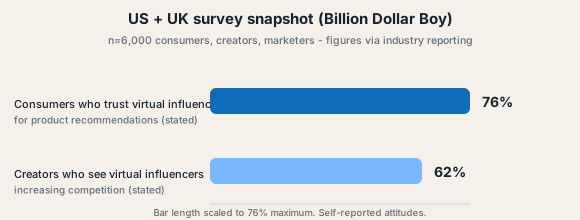
If you are on the fence about piloting an AI influencer, the practical case is simple: you get a brand-owned voice that can tighten homepage and campaign storytelling, speed up creative testing, and make your presence feel intentional instead of scattered. The charts in this article are third-party anchors so you can sanity-check budgets and attitudes before you commit.